




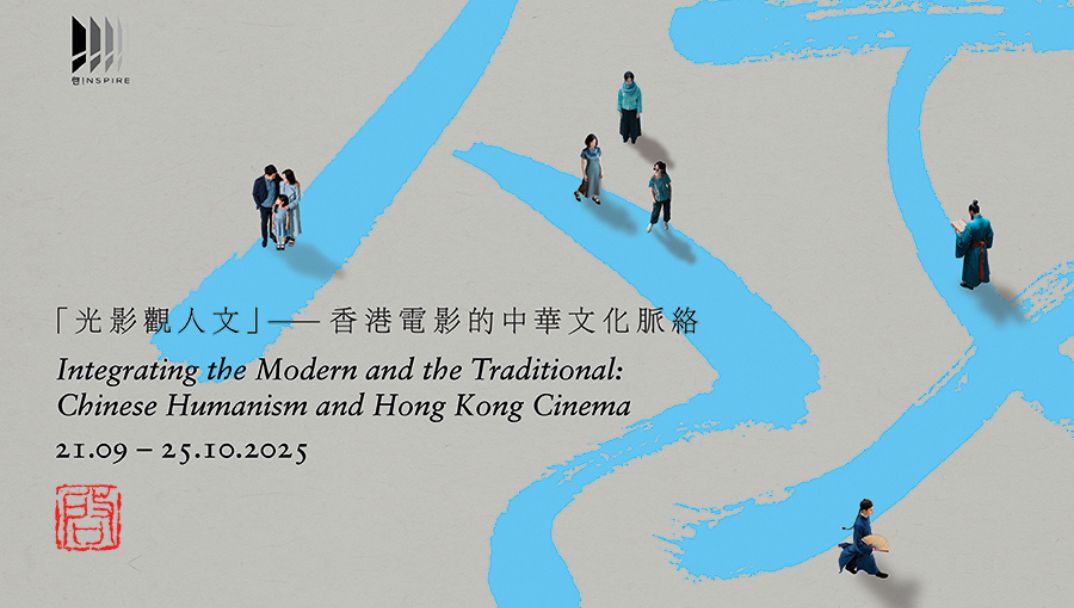
There is something fundamentally humanistic about popular culture. Produced with the purpose of being consumed by the masses, it cannot help but be connected to the people. And cinema, at once an art form, a communication medium and an industry, is a human endeavor that engages the heart, the mind, sometimes even the body of people.
Hong Kong cinema is a unique confluence of East and West, North and South. While we in Hong Kong often eagerly celebrate the longitudinal integration in our culture, the latitudinal dimension is sometimes neglected, taking for granted the rich heritage of Chinese culture. Film was invented in the West at a time when it was enjoying overwhelming and worldwide dominance, spreading quickly and profusely to the rest of the world. As such, every non-Western cinema is an arena of negotiation between Western influence and local culture. Hong Kong, located at the southern periphery of China, its culture an arena of ongoing integration with traditional tenets to begin with, developed a distinctive cinema, a fertile mosaic of cultural inspirations.
Part of that mosaic is a humanism that profoundly informs most Hong Kong films. A notion at once simple and complicated, Chinese humanism (ren wen zhu yi) has a long and vibrantly evolving history in Chinese thinking, cultivating values that became deeply rooted in our culture, shaping our thoughts, our behaviors and our expressions.
Crystallised from centuries of development, Chinese humanism is a synthesis of different schools of thought through different eras of history, preached by scholars and practiced by elites and ordinary folks alike. Anchored by Confucianism, it champions personal virtue and societal harmony. Striving for an ideal balance between the part and the whole, it is concerned with the moral interaction between the individual and the collective, on how a person interacts with family, nation and nature.
Chinese humanism also has a universal dimension, sharing common affinities with other cultures, Greek philosopher Aristotle’s Virtue Ethics a ready example. This is not unlike cinema’s capacity for culture crossing.
“Observe ren wen (human culture) to educate the world” is an early manifestation of Chinese humanism, found in The Book of Changes. Such a notion resonates with the Confucian belief of wen yi zai dao, meaning “the text carries the moral teaching”. Chinese films, Hong Kong entries included, are texts of human expression, based on observations of human activities, distilled by human creativity and inevitably carrying moral teachings. “Art for art’s sake” is a Western idea that remains essentially foreign to our cinema.
Film was introduced to China at a time of dramatic changes, when vigorous negotiations took place between the traditional and the modern. The Chinese people adjusted to the changes with various degrees of difficulties, resulting in a spirited evolution of values. Many aspects of that process have been captured by our cinema, in the stories about the people, told by the people and watched by the people. This programme is an exploration of how Chinese humanism informs the stories told by Hong Kong filmmakers and consumed by the people of Hong Kong and elsewhere.
The exploration will be taken from four different perspectives: the interplay of moral values involving family and nation, the role of the educated sector known as literati, the development of gender relationship and the legal dimension. Three films will be screened in each category, two of them Hong Kong productions from different eras and one a foreign film serving as reference. A seminar will be conducted for each category to provide opportunities for exchanging ideas while a post-screening talk will be given after each film.
Chinese humanism will continue to evolve with time, as will Hong Kong cinema. And stories of the people, for the people and by the people (including those generated by AI) will continue to be told. See you at the movies!
Co-curators
Sam Ho
Joyce Yang